Zhixi Cai
Monash University. Melbourne. Australia.



📘 I’m currently a Lecturer at VL4AI Research, Department of DSAI, Faculty of IT, Monash University. Working with A/Prof. Hamid Rezatofighi, my current core research area includes video/image spatial reasoning, neuro-symbolic AI, agentic AI, and embodied AI.
💡 We believe the next wave of AI will be agentic and verifiable systems that plan, act, and explain their decisions by composing neural perception with symbolic representations and logic. Progress will come from neuro-symbolic combination with built-in verifications. Our aim is AI that is safe-by-default, auditable, and robust.
🎓 I obtained my PhD in Monash University, supervised by A/Prof. Kalin Stefanov, A/Prof. Abhinav Dhall and Dr. Munawar Hayat in artificial intelligence domain. I completed my thesis Content-Driven Multimodal Deepfake Generation and Temporal Localization, which mainly focuses on deepfakes and video understanding.
🧠 I worked as a Research Fellow at VL4AI Research, Monash University, supervised by A/Prof. Hamid Rezatofighi. My postdoctoral research focused on compositional neuro-symbolic systems for visual reasoning, and embodied/robotics system.
🔬 Now I have first-author published papers in CVPR, ECCV, ICCV, ICLR, NeurIPS, ACM MM, etc, and get two best paper awards in my PhD journey. Please refer to the publication page for more details.
🔎 I’m the Area Chair of CVPR and the Associate Editor (Area Chair) of IROS. I’m also invited as the reviewer of CVPR, ICCV, ECCV, ACM MM, ICRA, TPAMI, TMM, TAFFC, and more.
🖥️ I enjoy programming and implementing some cool ideas. I have developed several interesting open source applications and libraries in my spare time. Please refer to the projects page for more details.
🛠️ Also, I love discovering and fine-tuning tools in my hand, including both software tools and physical tools.
news
| Oct 13, 2026 | Selected as a finalist for the Outstanding Associate Editor Award at IROS 2026. |
|---|---|
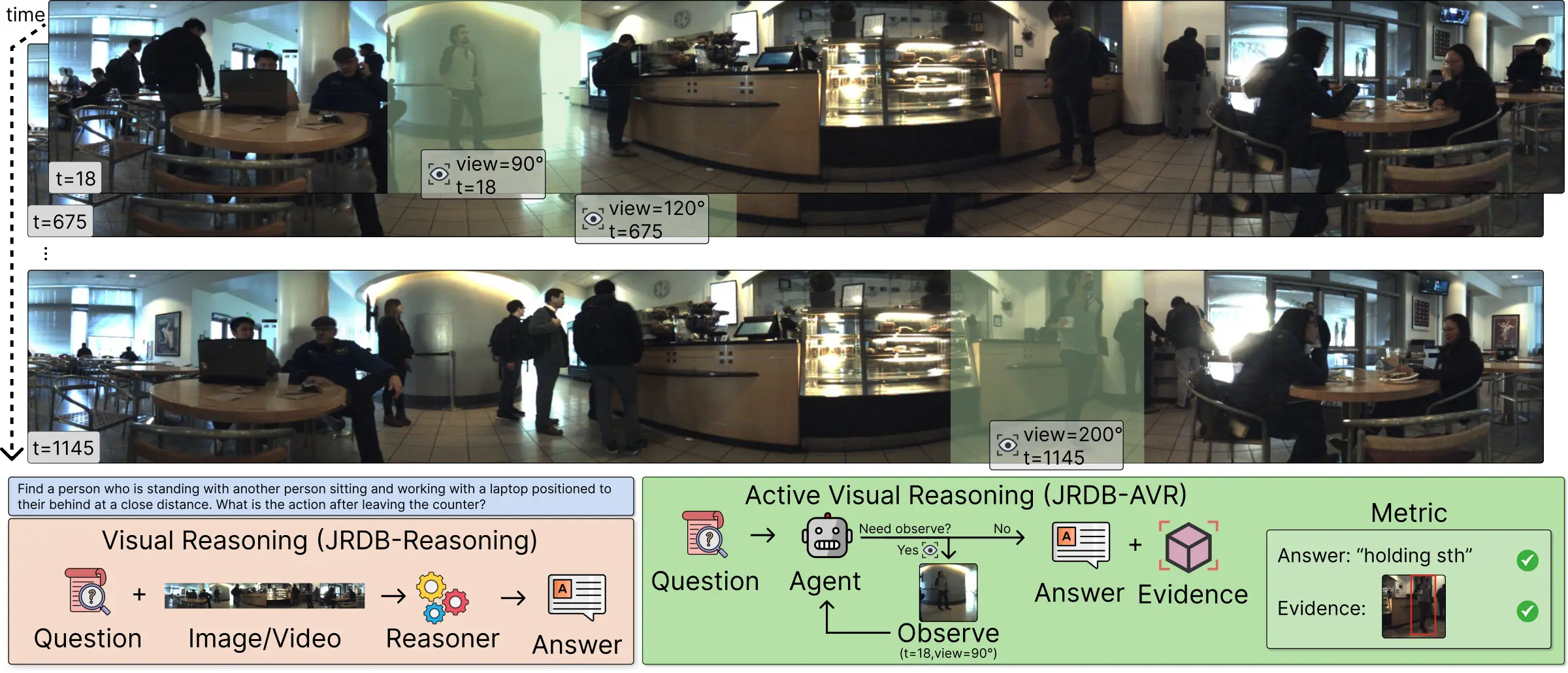
| Sep 28, 2026 | JRDB-AVR, accepted at NeurIPS 2026 (Track on Evaluations and Datasets), is now available on arXiv with code and benchmark. |
| Aug 01, 2026 | Joined Monash University as a Lecturer. |
| Jan 27, 2026 | MATA was accepted at ICLR 2026. |
| Nov 08, 2025 | A paper are accepted by AAAI 2026. |